








In Transactional Analysis (TA), loyalty bonds (often referred to as Invisible Loyalties or Scripted Loyalties) are the powerful, often unconscious attachments we maintain to our family of origin or significant early figures. Think of them as the “unwritten contracts” we sign as children to ensure we belong and remain safe within our family system.
How Loyalty Bonds Form
Children are biologically programmed to seek connection for survival. To maintain this connection, a child may adopt the family’s “Rules of Living,” even if those rules are self-limiting or destructive. In TA terms, this happens through the Script:
- The Parent Ego State: We internalise the values, prejudices, and expectations of our caregivers.
- The Child Ego State: We comply with these expectations to avoid the “threat” of abandonment or disapproval.
- These Child–Parent units are stored in implicit (non-verbal) memory.
Types of Loyalty Bonds
Loyalty isn’t always about being “good.” It’s about being like the family or fulfilling a role for the family.
| Type | Description | Example |
| Success/Failure Bond | Staying at a certain socioeconomic level to avoid “outshining” parents. | Always being the “troublemaker” because it keeps the parents focused on you rather than on their failing marriage. |
| Emotional Bond | Carrying the “forbidden” emotions of a parent. | A student subconsciously fails a bar exam because their father never finished high school. |
| Role Loyalty | Fulfilling a specific function (e.g., the Scapegoat or the Hero). | Always being the “troublemaker” because it keeps the parents focused on you instead of their failing marriage. |
| Suffering Bond | Staying in pain as a way to stay connected to a family history of trauma. | “We are people who struggle; ease is for others.” |
The “Cost” of Secret Loyalty
The conflict usually arises when your Adult Ego State wants to grow, but your Child Ego State feels that growing would be an act of “betrayal”. A bad relationship is often experienced as safer than no relationship at all.
- Existential Guilt: When you break a loyalty bond (e.g., by becoming wealthy, happy, or setting boundaries), you may feel a deep, irrational sense of guilt. This isn’t “bad person” guilt; it’s “traitor to the tribe” guilt.
- Self-Sabotage: To alleviate that guilt, people often sabotage their success to return to the “safety” of the family script.
- An attempt to preserve psychological survival
- Loyalty to an old internal relationship, even a painful one, and fear of
- Losing the internal “object”
- Falling into emptiness or “nothingness”
- Being retraumatised
Breaking the Bond (Redecision)
Healing in TA involves moving from blind loyalty to conscious choice.
- Awareness: Identify the “injunctions” (e.g., “Don’t be important,” “Don’t be happy”).
- Externalisation: Recognising that “this is my mother’s fear, not my reality.”
- Permission: Giving yourself the “Adult” permission to thrive without losing your sense of belonging.
- Redecision: Actively deciding to write a new script that honours your current life while acknowledging (but not necessarily following) the old family rules.
The Goal: It’s not about hating or cutting off the family; it’s about becoming autonomous. You can love your family while declining to carry their “bricks” anymore.
The Internal Relational Loop

The bond is reinforced by the Ego State Relational Unit, where the Child and Parent are locked in a closed system.
- The Adapted Response: The individual adopts an “Adapted Child” state to appease the “Influencing Parent,” creating a stable, albeit miserable, homeostasis.
- Hope as a Trap: The Child clings to the tie in the secret hope that if they change enough, the “bad” object will finally become the “good,” loving parent they originally needed.
- Guilt and Responsibility: The individual often believes it is their own fault they weren’t loved, leading them to stay in the relationship to “fix” themselves and earn that love.
Defensive Barriers to Leaving
Toxic relationships are often preserved through Narcissistic and Primitive Defenses.
- Devaluation of Reality: The “Psychotic Mind” or part of the personality may actively hate or reject the reality of the abuse to protect the internal bond.
- Splitting: The individual splits the partner into “all-good” (idealised) and “all-bad” (persecutory) versions. They stay by clinging to the idealised image while dissociating from the abusive behaviour.
- Narcissistic Bubble: The couple may enter a “cocoon” or fused state that ignores the outside world, making the idea of being a “separate” individual feel like a death sentence.
Transformation through the “Needed Relationship”
Breaking the bond of loyalty requires a shift from a Repeated Relationship (the toxic loop) to a Needed Relationship.
- Developing Separateness: The goal is to achieve “psychological separateness”—the capacity to be an individual within a relationship rather than being fused to it.
- Grieving the Ideal: The individual must face the Mortificatio (the death of the false, idealised image) and accept the genuine sadness of what was never provided.
- Internalising a New Object: In therapy, the individual begins to replace the “bad” internal object with a new, stable, and empathetic experience, allowing them to finally let go of the toxic tie without falling into the “void”
THE BOND OF LOYALTY TO THE BAD OBJECT: AN EGOSYSTATE DIAGRAM

- Layout: A large P-A-C diagram on aged parchment, showing internal fragmentation and defence mechanisms, with the Parent Ego State (P) Split into two. The left side: “PERSECUTORY INTROJECT” (Red, jagged border). Contains icons: a scowling face, a crushing fist, “CRITICISM,” “ABUSE,” and text: “Taken in Whole (Confusion).”Adult Ego State (A): Depicted as “FRAGILE & CONTAMINATED” (Light grey, permeable border), a cracked magnifying glass, where “REALITY DEVALUED,” and denied: The Adult ego state is permeable and “Contaminated,” unable to objectively assess the danger or hostility, and devaluing reality to maintain the bond.Child Ego State (C): Split into two. The main Child structure has an arrow pointing towards a massive, dark abyss at the bottom: “THE TERROR OF OBJECTLESSNESS” and the “EMPTY VOID”. The diagram demonstrates that the individual prefers the painful bond over falling into this void. The “Bond of Loyalty”: A thick, heavy, chain-link arrow loop (black and red) labelled “THE BOND OF LOYALTY (REPEAT LOOP)” connects the “PERSECUTORY INTROJECT” (P) and the “ADAPTED CHILD” (C).
Key Mechanisms
- Key Mechanism 1 (Hope): An arrow from “ADAPTED CHILD” (C) to “IDEALIZED PARENT” (P) labelled “UNCONSCIOUS HOPE: ‘IF I CHANGE, THEY WILL LOVE ME’.”
- Key Mechanism 2 (The Void): A large, dark “EMPTY VOID” or “BLACK HOLE” at the very bottom centre of the whole diagram, labelled “FANTASY OF TOTAL ISOLATION.” A heavy red dashed arrow from the entire C structure points to this void, labelled “THE TERROR OF OBJECTLESSNESS.”
- Key Mechanism 3 (Projection): Projective Identification: A small external diagram on the right illustrates how the individual might manage internal conflict by “depositing” or projecting unwanted parts (like the Shadow C) into the “TOXIC PARTNER (CONTAINER).” This is a form of communication and control in the relationship.
The “bond of loyalty” is a powerful psychological mechanism that explains why individuals remain in toxic or self-defeating relationships, often preferring a “painful predictability” over the terror of being alone.
Narcissism and the “Empty Void”
Narcissistic structures work as a type of defensive organisation used to protect a fragile, “unborn” potential.
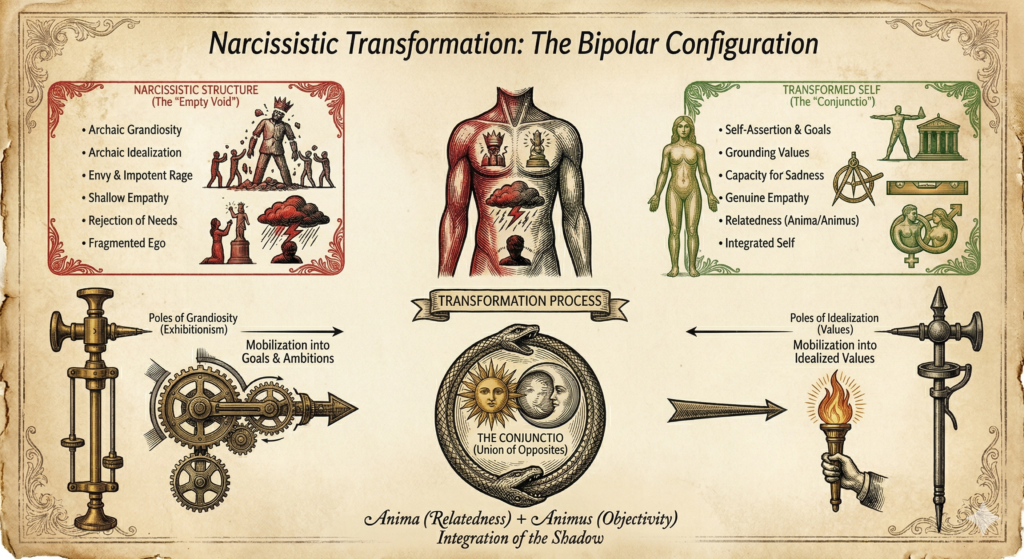
- Bipolar Configuration: The narcissistic self is split between a “Grandioso” pole (exhibitionism and self-assertion) and an “Idealised” pole (values and grounding principles).
- The Hall of Mirrors: The individual lacks a genuine sense of self and relies on others for “tribute” and constant validation.
- Envy and Rage: Deeply buried “impotent rage” and envy of others arise in response to a perceived hostile world and an inability to have basic needs met.
- Devaluation: To avoid the pain of “wanting” something from someone else, the individual may devalue the person or object to protect their sense of omnipotence.
Confusion and Introjection
The ego becomes “confused” through the process of introjection.
- Defensive Splitting: When an infant faces a traumatic or “bad” object (caretaker), they split their ego to manage the pain.
- Introjection vs. Assimilation: “Good” experiences are assimilated into the healthy self, while “unsatisfactory” experiences are introjected—taken in whole as a rigid, unchangeable Parent ego state.
- Bond of Loyalty: Clients often resist change because of a “bond of loyalty” to these internal bad objects. They may prefer a painful, predictable relationship with an internal “bad” parent over the “black hole” of having no relationship at all.
The Transformation (The Conjunctio)
By dismantling the “Repeated Relationship” loop in the transference, the individual can grieve the “Idealised Parent,” accept genuine sadness, and move from being a victim to becoming an integrated agent. This requires shifting from a non-verbal narrative of loyalty to a shared verbal narrative of insight and integration. The goal of therapy in these models is the Conjunctio—the alchemical “union of opposites” where fragmented parts of the self are integrated.
- Mobilisation of Grandiosity: Primitive exhibitionism is transformed into healthy ambition and goals.
- From Victim to Agent: By working through the “repeated relationship” (the old template) in therapy, the client can eventually find the “needed relationship,” leading to a Capacity for genuine sadness, empathy, and an integrated sense of history.
- Relatedness (Anima/Animus): Transformation involves balancing the “inner feminine” (relatedness and mirroring) with the “inner masculine” (reflection and objectivity).
| Concept | The Narcissistic State | The Transformed/Integrated State |
| View of Others | Objects for validation or “supply”. | Separate beings with their own reality. |
| Internal World | Fragmented, “Empty Void,” Enraged. | Integrated, grounded, capable of suffering. |
| Ego Defense | Splitting, Devaluation, Idealization. | Object constancy and reality testing. |
| Relational Goal | Symbiotic “Narcissistic Bubble”. | Conjunctio: The Union of Opposites. |



